
![You are currently viewing CO2 Geological Storage in Latvia now allowed! [09.10.2025]](https://shogenergy.eu/wp-content/uploads/2025/10/IMG_5614-scaled.jpg)
BREAKING NEWS!
🇱🇻 🇪🇪🇱🇹Make CCUS Great in the Baltics!
A Historical Day for the Baltic CCUS!
📅 Thursday, October 9, 2025, was a truly special day for us — the pioneers of CCUS in the Baltics.
🇱🇻 The Latvian Parliament officially approved geological CO₂ storage in the country’s subsurface!
🔥This is not just a political decision — this is a victory! A historical milestone.
We have been working toward this day with everything we had: through research, innovative concepts, modelling, participation in dozens of scientific projects, publishing over 60 scientific papers, and developing educational courses for students, industry, and policymakers — and by actively engaging with the media.
For nearly 20 years, we have been promoting the idea of CO₂ storage in Latvia — the best place for it in Eastern Europe 🇱🇻🇪🇺
🎯 And finally, the wall has fallen. The goal has been achieved.
At times, we stopped believing in success — but we kept working with discipline and faith in our mission.
And this proves one thing: discipline and belief in your success bring results.
🤝 We thank and congratulate everyone who has been part of this journey — this is our shared victory: the Baltic Carbon Forum, Bellona, BASRECCS, Latvenergo, and Schwenk Latvia Cement Plant, along with many others who contributed.
Thank you all — and thanks to the Almighty!
Hooray!
Let’s make CCUS great in the Baltics!
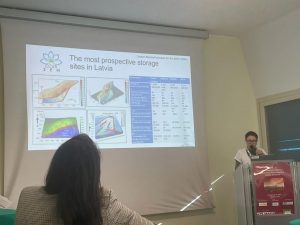
📸 On the photos — our Latvian friends and colleagues from Riga Technical University, Latvenergo, Bellona, Connexus, and Schwenk.
And also, our partner from the USA (Avalon Corp.) Dr Eugene Holubnyak, director of Hydrogen Institute at Wyoming Technological University, future doctoral student and hopefully SHOGenergy employee, Elizavetta Kushnarev from ELME MESSER GAAS and representative from Estonian Ministry of Climate, Maria Värton.
⚙️ Hard work is waiting!
⸻
ℹ️ 🇪🇪 What does this mean for Estonia?
Estonia can now continue to use its main national resource – oil shale – to produce affordable energy while capturing CO₂ and transporting it for storage in Latvia’s geological structures. This scenario is significantly cheaper than transporting CO₂ to the North Sea.
And with a new technology – injecting CO₂ directly from ships (CETP CTS PROJECT) into offshore underground structures (details and figures were presented at the Baltic Carbon Forum in Tallinn) – the total cost can be reduced by up to half a billion euros over the 30–35-year project lifetime.
Make Estonia Great Again!
![Read more about the article BCF-2024 (Baltic Carbon Forum)[3-4.10.2024]](https://shogenergy.eu/wp-content/uploads/2024/10/4DE50FCA-278D-441D-AFBB-3344826D202E_1_105_c-1-225x300.jpeg)